
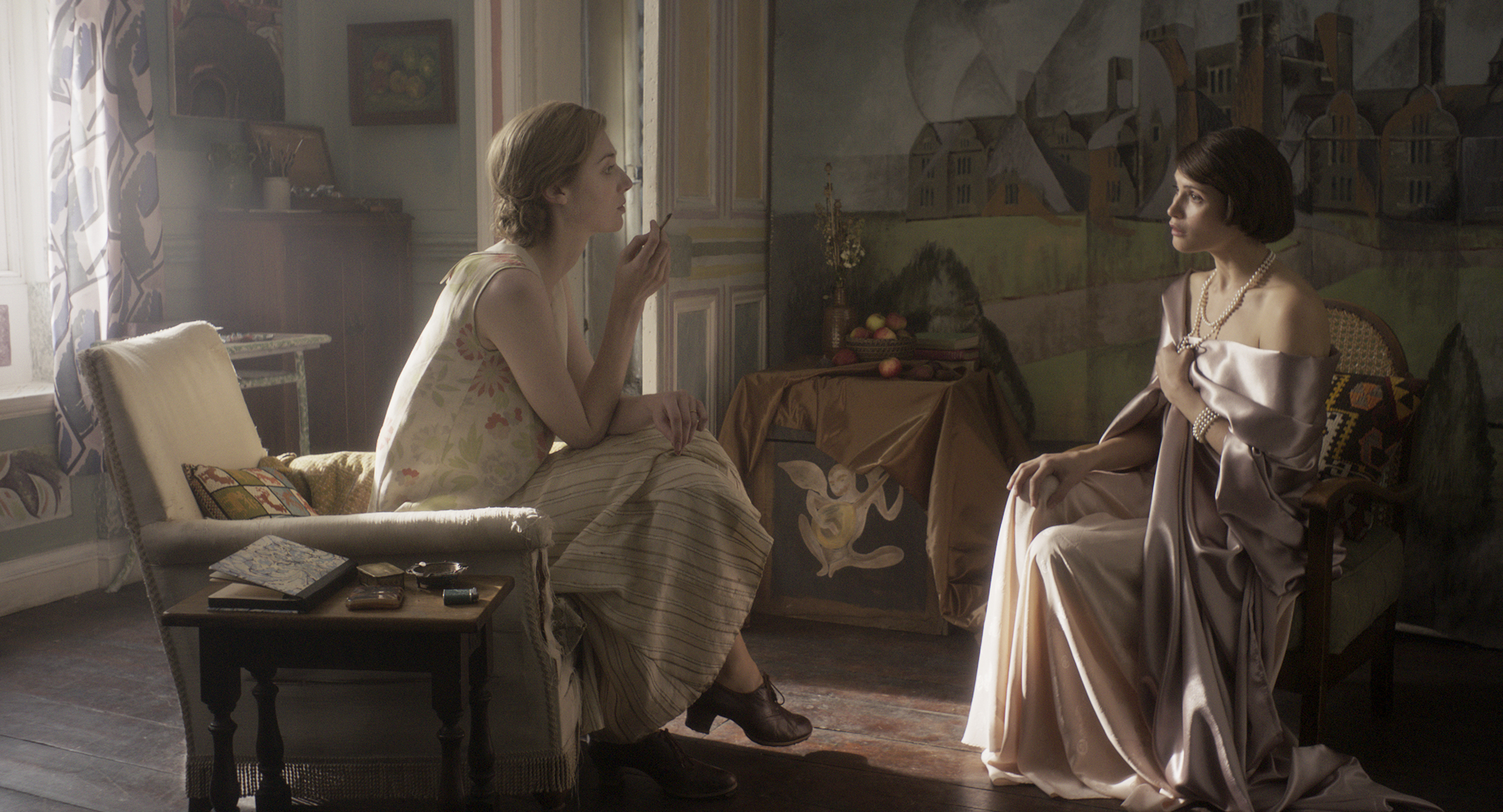
Still Source: IMDB
Director: Chanya Button
Screenplay: Eileen Atkins, Chanya Buttom
Cast: Gemma Atherton, Elizabeth Debicki, Isabella Rosellini, Rupert Penry-Jones, Peter Ferdinando, Adam Guillen, Gethin Anthony, Karla Crome, Elizabeth Fennell,
Distributor: Thunderbird Releasing
Year: 2019
Where to Watch*: Kanopy AppleTV, AmazonPrime, YouTube, GooglePlay, Vudu
The topic promised in the title is the main draw: the relationship between literary icons Vita Sackville-West and Virginia Woolf, showing how Woolf was ultimately inspired to write Orlando: A Biography, fictionalizing Sackville-West as this figure who transcends gender and time, yet is at odds with the times.

Still Source: IMDB
It’s also the story of one writer trying to impress another. At this time, the viewer is told that Vita Sackville-West sells more and is more famous than the independently publishing Virginia Woolf. There is a lot of telling in this regard to establish who Sackville-West is and her feelings about herself as a writer in comparison to Woolfe. This is only one part how the film works on showing a relationship with text.
As a recurring motif, the scenes where Virginia reads letters from Vita, these are shown in montages where instead of having her eyes down to show reading, she stares off to show the viewer she is immersed, hearing them read to her by Vita as the text blends in, moving to key words or phrases. These sequences are not meant only to show the power of the text but of the one creating it. Also, these moments lead to where writing and desire become inseparable, down to when Virginia is scribbling down Orlando, only for Vita’s image and voice saying the words over her voice.

Still Source: IMDB
While this literary relationship eventually leads to a sexual one, it is the reading of the letters that feel more intimate in their presentation. With the montages and moments showing typesetting (moveable type and printing plates!) and bookbinding, Vita & Virginia definitely feels like book lover’s porn. This wouldn’t feel complete without Vita reading and then showing up at Virginia’s doorstep to gush about it, or in the preceding moment where her mother (formidably portrayed by Isabella Rossellini) clearly paid attention and was angered by the contents. After all, this film is about the creation of one of Virginia Woolf’s greatest novels (which would later be wonderfully adapted to film by Sally Potter).
I have to admit I found this film better on a second viewing. The sound design is a bit clunky and the non-diegetic throbbing electronica arpreggios were distracting as feeling anachronistic for the scoring. With its glossy cinematography, at times, Vita & Virginia felt more television than cinema. As for the cast, Gemma Atherton is consistently charming as Vita Sackville-West but is easily upstaged by her screen mother Isabella Rosellini as the Baroness Sackville-West. Elizabeth Debicki’s Virginia Woolf gets lost a bit and in the first half, the thing that anchors her for the viewer is that Virginia Woolf obviously is an important reason to pay attention to. As for the men in this film, it’s hard to forget Adam Guillen’s Duncan Grant as Virginia Woolf’s gay best friend while Peter Fernado’s Leonard Woolf almost disappears in his print shop. The splashy characters capture the most attention and it’s only on the second watch I could appreciate the not-so-splashy oness. Even with this unbalanced execution, the film’s best selling point is the story of Vita & Virginia.
 It's a Sin Queer Cinema Podcast
Leave a comment